|
|
|||
|
FORT STOCKTON TEXAS |
|||
|
|
|||
|
Fort Stockton was abandoned by the army in 1886. By then developers from San Antonio decided the springs could be a gold mine to be used for irrigating the arid land. So, they bought a large amount of land in the area. Gradually a town was born. At first named Saint Gaul. But the locals did not like that name. And so in 1881 Saint Gaul became Fort Stockton. |
|||
|
The irrigation effort was one of the earliest irrigated farming attempts in Texas. By 1877 around 8,000 acres were getting water. Today Fort Stockton is the retail, shipping headquarters for vast natural gas, oil and ranching operations. There is good hunting in the Fort Stockton zone, with a lot of mule deer and antelope. In Fort Stockton you'll find Annie Riggs Hotel Museum. This is an old hotel, built in 1899, that has been restored by a local historical society with 14 rooms displaying collections of various items from Fort Stockton's past. Comanche Springs is still burbling up water, but not as much as in its heyday. It is now the site of an Olympic sized swimming pool. |
|
||
|
Fort Stockton has one of those classic Texas county courthouse squares with
several old building around the courthouse. There are some very big ranches in the Fort Stockton area. La Escalera Ranch sprawls over 320,000 acres. It is located south of Fort Stockton on the Marathon Highway (385). La Escalera Ranch was owned by the Giddings family for over 100 years, during which time it was known as Elsinore Ranch. La Escalera Ranch covers much of Pecos County and parts of Baylor, Reeves and Brewster counties. The ranch is known for its herd of Black Angus. the Sierra Madera meteor crater is located near the entrance to La Escalera Ranch. |
|||
|
|
|||
|
|||
|
|||
|
Visit
our Eyes on Texas Blog to make a |
|||
|
|
|||
|
|
|||
| HOME TEXAS TOWNS PARADES | |||
|
|
|||
| BIG BEND COUNTRY | |||
| GULF COAST PINEY WOODS | |||
| PRAIRIE & LAKES HILL COUNTRY | |||
| SOUTH TEXAS PLAINS | |||
| PANHANDLE PLAINS | |||
|
|
|||
| Del Rio El Paso Fort Davis | |||
| Fort Stockton Langtry Marfa | |||
| Midland Monahans Odessa Pecos | |||
| Sanderson Terlingua Wink | |||
| Guadalupe Mountains National Park | |||

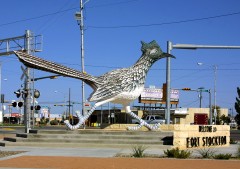 Fort
Stockton is in Pecos County. At last count there were 7,846 people living in
Fort Stockton.
Fort
Stockton is in Pecos County. At last count there were 7,846 people living in
Fort Stockton.